
Seeing the invisible: the Schlieren technique, from crystallography to breathing
Air is transparent, but it is not uniform: wherever temperature, density or composition change, the way light travels through it changes too. The Schlieren technique exploits these tiny differences to reveal flows we would never see with the naked eye: a person’s breath, warm air rising from a hand, the jet of a heated nozzle.
The principle: light that bends
A light ray crossing a region where the refractive index is not uniform is slightly deflected. The deflections are tiny, fractions of a degree, but they can be turned into changes in brightness.
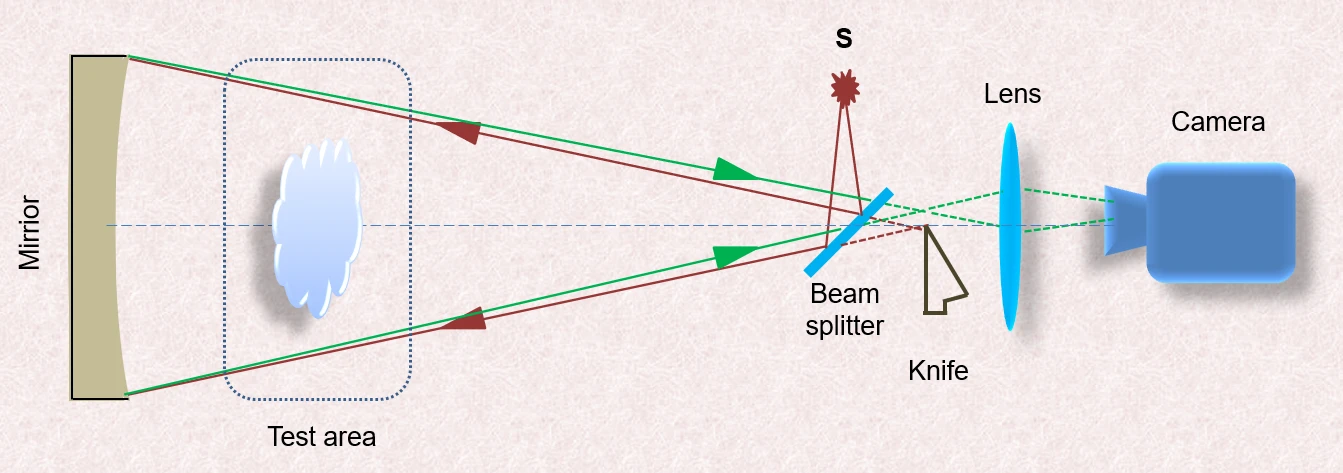
In the single-mirror configuration, light from a point LED source is sent through a beam splitter to a concave mirror placed at twice its focal length. The mirror sends the light back and focuses it on a thin metal blade (the “knife”), which blocks part of it. Behind the blade, a lens and a video camera capture the image of the test area, the space in front of the mirror where the flow being studied is located.
When the air is uniform, the blade always blocks the same portion of light and the image is even. Rays deflected by the flow land slightly above or below the blade: some are blocked, others pass. Lighter and darker areas then appear in the image, drawing the shape of the flow. And since the light crosses the test area twice, on its way to and back from the mirror, the deflections add up and the system gains sensitivity.
The Schlieren Laboratory apparatus
The apparatus used at the Department of Earth and Geoenvironmental Sciences (DiSTeGeo) of the University of Bari, developed within the FISR2020 project, was designed for portability, ease of use and flexibility. It consists essentially of two units:
- the astronomical-grade spherical mirror: 300 mm in diameter, focal ratio f/5.3 (about 1.6 m focal length), surface accuracy λ/8. It sits on a purpose-built mount with a digital inclinometer for horizontal alignment with the acquisition unit, and on a motorised stage allowing vertical movements with millimetre precision;
- the video acquisition unit: LED source, beam splitter, blade, optical components and a high-resolution camera, mounted on a six-degrees-of-freedom positioning system that provides the precise optical alignment needed for high-quality recordings.
From crystallography to breathing
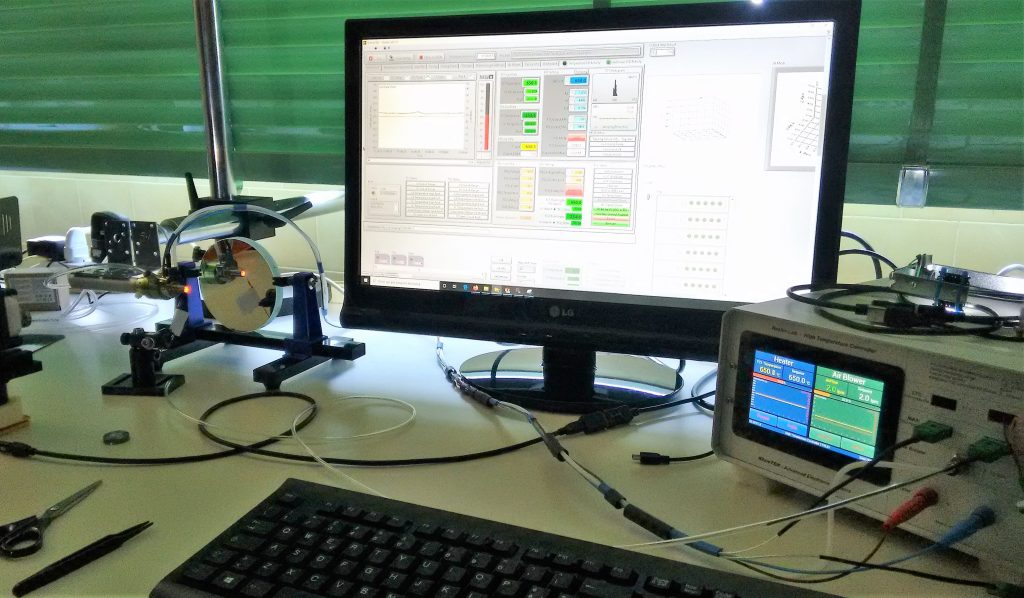
The technique was first applied to characterising the flow generated by a mini air heater used in X-ray diffractometry: a jet of hot gas keeps the sample at the required temperature, and the stability of the flow directly affects the quality of the measurements. Another case study is the analysis of the filtering action of surgical masks, made visible by observing how exhaled air passes through them or escapes at the edges.
Over time its uses have multiplied. The laboratory lists among its applications:
- the analysis of expiratory flows in humans and animals;
- the study of convective motions and air flows in the environment;
- boundary layers and shock waves in aerodynamics;
- checking the surface accuracy of precision mirrors.
Within a FISR2020 project the laboratory was upgraded with two dedicated systems: one to assess the filtering efficiency and fit of protective masks, the other to study air circulation in environments that are critical from a health and hygiene point of view.
Next developments
An upgrade is under way with a motorised hexapod positioning system: it will make the apparatus more compact and easier to transport, and the optical alignment extremely fast and accurate.
KleisTEK’s contribution
KleisTEK designed and built the entire system in collaboration with the university researchers: an example of how we work, starting from the needs of research to deliver a complete and reliable instrument. The project was also presented to the public at “European Researchers’ Night” 2023 in Bari.
Further information: Schlieren Laboratory page (DiSTeGeo, University of Bari Aldo Moro; scientific supervisor Prof. Gennaro Ventruti, in Italian).